
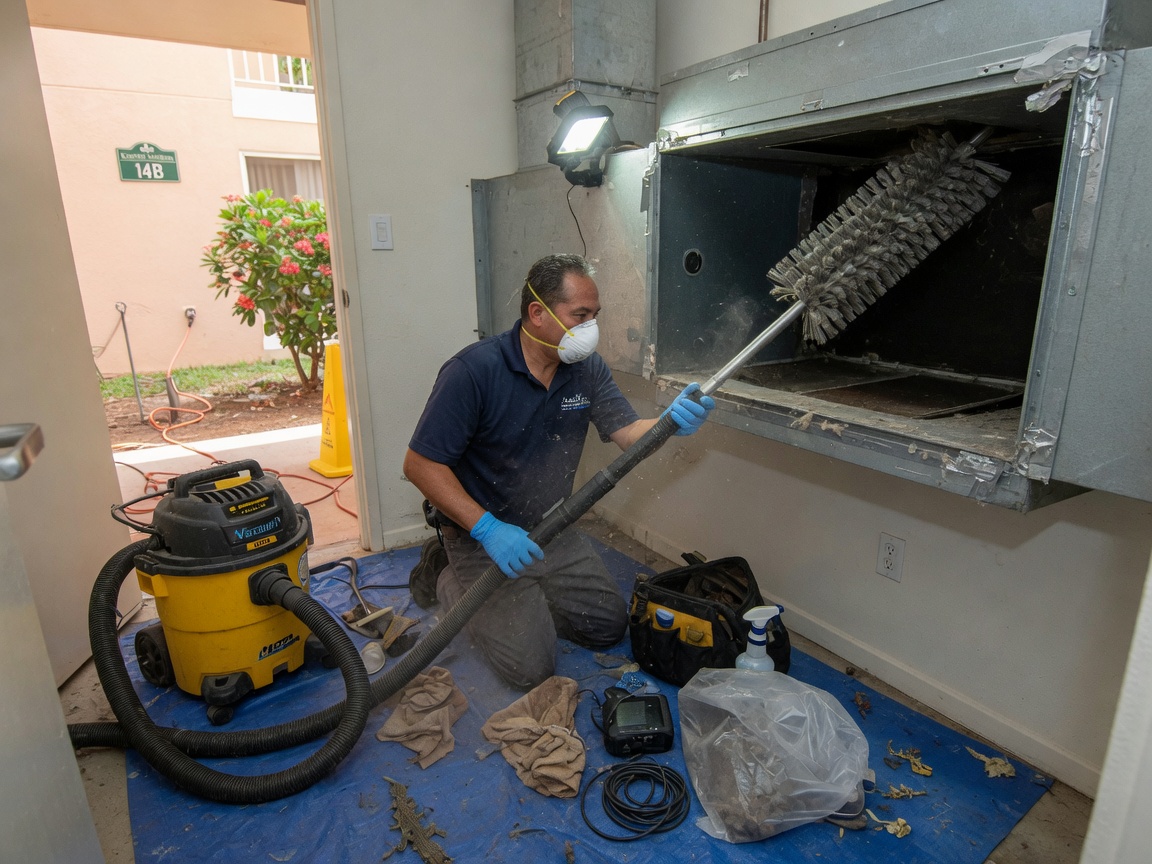
Kapolei homes built near the Hawaii Railway Museum and Kapolei Regional Park often run central air systems exposed to constant trade winds that carry fine red dust and salt from Ewa Beach and Waianae. Over time this dust settles in supply and return lines, reducing airflow and creating spots where humidity from the tropical climate encourages mold growth inside the ducts. Cleaning requires removing registers, brushing main trunks with rotating whips sized for typical 6- to 8-inch flex runs found in these neighborhoods, then vacuuming with HEPA equipment to capture the fine particulate without blowing it back into living spaces.
Ko Olina Resort-area condos and single-family homes in Makakilo frequently have longer duct runs routed through hot attics. These runs collect sticky residue from ocean air and occasional vog that settles when winds shift. Technicians must check for disconnected sections or crushed flex near the air handler, especially in homes where roof-mounted units sit close to the trade-wind path. Proper cleaning includes sealing access points afterward so wind-driven dust does not re-enter the system within weeks.
Because Honolulu County does not require special licensing for residential duct cleaning, the real difference shows up in the equipment and thoroughness. Skipping the return-side plenums or failing to clean the blower wheel leaves the majority of the load untouched. In Kapolei’s newer subdivisions, many systems also have zoning dampers that must be opened and closed during the job to reach every branch.
Technician insight
In Kapolei the thing that catches most people out with HVAC duct cleaning is the fine red dust the trade winds keep pushing in from the Ewa plain. If you only vacuum the registers and skip the main trunks that run through the hot attic, the system loads back up in a month. Newer homes near Ko Olina also have zoning dampers that must be manually opened during the job or half the branches stay dirty.
Dust buildup in Makakilo split-level
A homeowner in Makakilo noticed weaker airflow on the upper floor after months of steady trade winds. Inspection showed thick red dust and a partially crushed flex run near the air handler. We opened the main trunk, agitated and vacuumed every branch, repaired the crushed section, and resealed all access points. Airflow returned to normal and the homeowner reported the system cycling less often.
HVAC Duct Cleaning Services We Offer
✓Residential Duct Cleaning
Full trunk and branch cleaning for single-family homes in Kapolei and Makakilo using HEPA vacuum and rotating brushes sized for local flex duct.
✓Mold Removal From Ducts
Inspection and antimicrobial treatment of ducts showing visible growth caused by high humidity in Ko Olina and Kapolei properties.
✓Commercial Duct Cleaning
Cleaning of larger trunk lines and rooftop units serving small retail and office spaces near Kapolei Regional Park and the resort corridor.
✓Dryer Vent Cleaning
Clearing lint and dust from dryer exhaust lines that often share wall cavities with HVAC returns in Kapolei townhomes.
✓Air Handler Coil Cleaning
Evaporator coil and blower wheel cleaning performed at the same time as duct work to restore airflow in trade-wind exposed systems.
HVAC Duct Cleaning Cost in Kapolei, HI
| Service | Typical Range | What Affects It |
|---|---|---|
| Whole-home duct cleaning (under 2,000 sq ft) | $450–$750 | Price rises with number of zones or when mold treatment is added. |
| Whole-home duct cleaning (2,000–3,000 sq ft) | $650–$950 | Longer runs common in Makakilo hillside homes increase time on site. |
| Mold treatment add-on | $200–$350 | Applied after cleaning when visible growth is confirmed. |
| Dryer vent add-on | $125–$200 | Often scheduled together when the dryer line shares a wall with HVAC ducts. |
Ranges are typical for Kapolei, HI and confirmed with an exact written quote before any work starts.
How it works
- 1
System Inspection
Technician checks every accessible duct run, registers, and the air handler for dust load, disconnected sections, and mold in Kapolei homes.
- 2
Register and Access Removal
All supply and return registers are taken off and the main trunk lines are opened at strategic points without damaging drywall in newer Makakilo builds.
- 3
Agitation and Vacuum
Rotating brushes loosen debris while a negative-air machine pulls everything out through the return, capturing fine red dust typical of the area.
- 4
Final Seal and Test
Access points are resealed, registers reinstalled, and the system is run to confirm improved airflow before leaving the Ko Olina or Kapolei job site.
Pricing
Most Kapolei homes fall in the mid-range because of moderate duct lengths and standard access; larger Ko Olina properties or those with mold cost more.