
2026-10-07 · Makoa Inouye
What Kapolei Residents Pay for Typical AC Repair Jobs
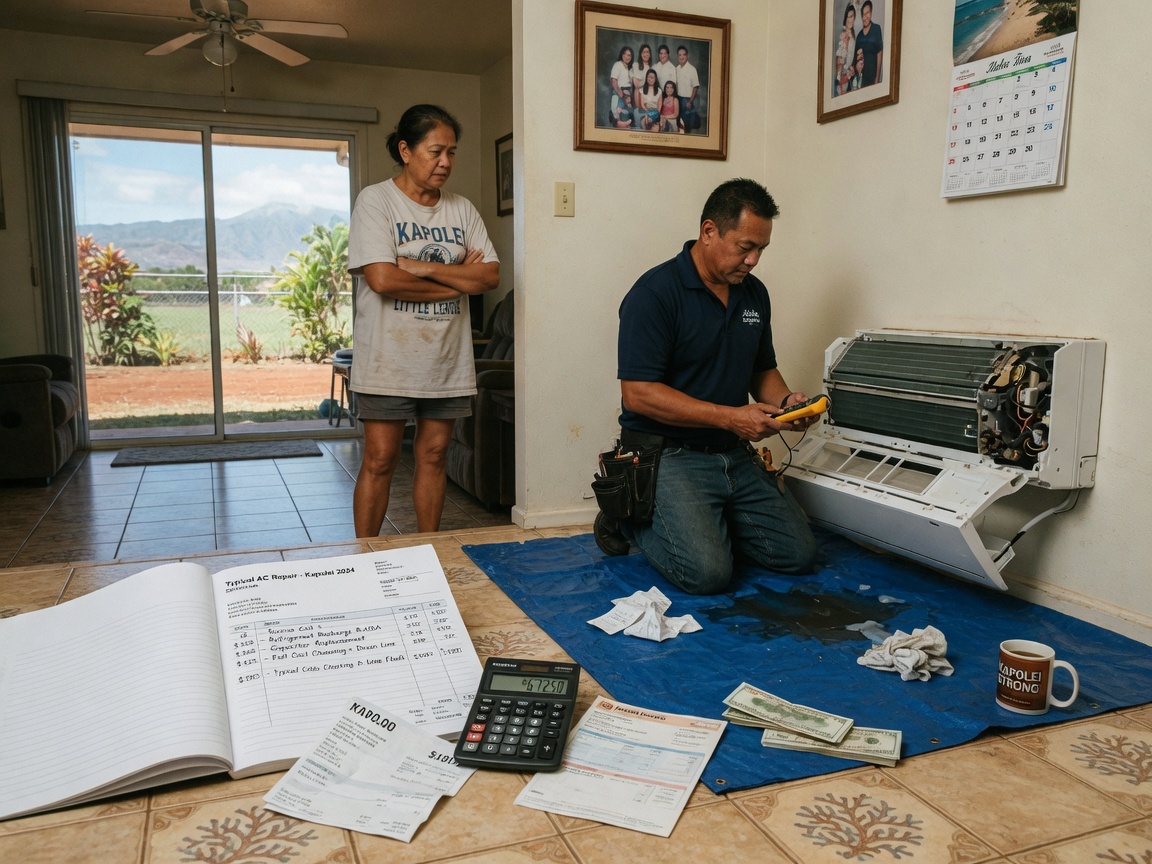
Kapolei residents pay $250–$450 for capacitor or thermostat replacements, $400–$650 for refrigerant leaks or coil cleanings, and $600–$850 for compressor or fan motor work on most single-story homes. These ranges reflect current parts and labor rates for Honolulu County properties built between 1995 and 2015 that rely on central systems sized for 1,800–2,400 square feet.
Common Repair Jobs and Their Price Ranges
Most service calls in Kapolei start with a $95 diagnostic that is credited toward the repair. Capacitor failures appear often because constant trade winds push fine dust into outdoor units near Kapolei Regional Park. A new dual-run capacitor plus labor runs $250–$320. Refrigerant leaks at flare fittings or Schrader valves typically cost $400–$550 once the system is recovered, leak-tested, and recharged. Blower motor replacements on older Carrier and Goodman units average $550–$720 when the motor must be ordered same-day from Oahu suppliers. These figures cover the majority of calls in Kapolei and nearby Ewa Beach neighborhoods where homes sit on concrete slabs with limited attic access.
How Tropical Climate and Trade Winds Change Repair Costs
Year-round warm temperatures and steady trade winds increase runtime, so capacitors and contactors wear faster than on the mainland. Salt-laden air from the coast near Ko Olina Resort corrodes condenser fins, raising the chance that a simple cleaning turns into a coil replacement at $750–$950. Humidity levels above 70 percent most months also cause condensate drains to clog with algae, leading to $180–$275 wet-switch and drain-line jobs. Technicians working in Makakilo’s hillside homes often spend extra time securing ladders on sloped driveways, which adds 30–45 minutes to each ticket compared with flat lots in central Kapolei.
Price Differences Across Kapolei, Makakilo, and Ko Olina
Single-family homes in Kapolei’s newer subdivisions usually have accessible attic units, keeping labor at the lower end of each range. Makakilo properties built in the 1980s often have equipment tucked under low eaves or on rooftops, pushing labor to the higher side of $650–$850 for motor or board replacements. Ko Olina Resort-area condos and townhomes frequently require coordination with HOAs and may involve crane fees for rooftop package units, adding $200–$300 to the base repair. Homes closer to the Hawaii Railway Museum experience slightly more dust during cane-harvest season, increasing filter and coil-cleaning frequency.
Maintenance Steps That Keep Repair Costs Down
Scheduling AC Maintenance twice a year catches weak capacitors before they fail during peak summer loads. Replacing filters every 30–45 days prevents the blower from working harder in humid conditions. Homeowners who add a smart thermostat can reduce runtime by 8–12 percent, directly lowering wear on contactors and motors. Keeping vegetation three feet from outdoor units near trade-wind paths cuts cleaning costs by roughly half. These habits typically keep annual repair spending under $300 for well-maintained systems in Honolulu County.
When Repair Costs Point Toward Replacement
If a single repair exceeds $900 or multiple visits total more than $1,200 within 18 months, replacement often makes more sense for 12–15-year-old equipment. Systems in Kapolei’s original 1990s subdivisions now face higher parts scarcity, which inflates repair prices. Switching to a high-efficiency unit through AC Installation can cut monthly electric use enough to offset the new equipment over seven to nine years. Local humidity also makes dehumidifier installation worth considering during replacement to reduce future coil-cleaning frequency.
Planning Your Next Service Call
Call 24/7 dispatch at 2114 Lauwiliwili St, Ste 101H when the system stops cooling or shows error codes. Technicians familiar with Kapolei’s housing stock can quote most jobs over the phone once symptoms are described. Keeping the model and serial number handy speeds diagnosis and avoids surprise part delays common on Oahu. Regular attention to the issues outlined above helps residents budget accurately and avoid peak-season premiums.